Manhattan: The Grid That Built a City
How the 1811 Commissioners' Plan transformed a hilly island into the world's most famous urban grid, shaping the identity of New York City forever.
In 1807, New York State appointed three commissioners—Gouverneur Morris, John Rutherfurd, and Simeon De Witt—to plan the future of Manhattan. The island was still largely rural, with farms, estates, and winding colonial roads. What emerged from their deliberations would become one of the most influential urban plans in history: the 1811 Commissioners' Plan for New York.
The plan was remarkably simple. Twelve north-south avenues, running the length of the island, intersected with 155 east-west streets. This created a rigid rectangular grid that ignored the island's natural topography. Hills were flattened. Streams were buried. The organic chaos of colonial New York was replaced by geometric order.
Critics called it unimaginative. The poet Walt Whitman lamented the loss of 'noble hills' and 'beautiful valleys.' But the grid had an undeniable economic logic. It maximized the number of buildable lots, facilitated real estate transactions, and allowed the city to expand northward in predictable increments. By the 1850s, the grid had reached 42nd Street. By 1900, it extended to the Harlem River.
The grid also shaped the city's identity. The numbered streets and avenues became a language unto themselves. 'Meet me at 53rd and Broadway'—such directions are only possible in a city of pure geometry. The grid enabled the skyscraper, as uniform blocks allowed developers to build higher with confidence. It created the canyon-like streets that define Manhattan's iconic skyline.
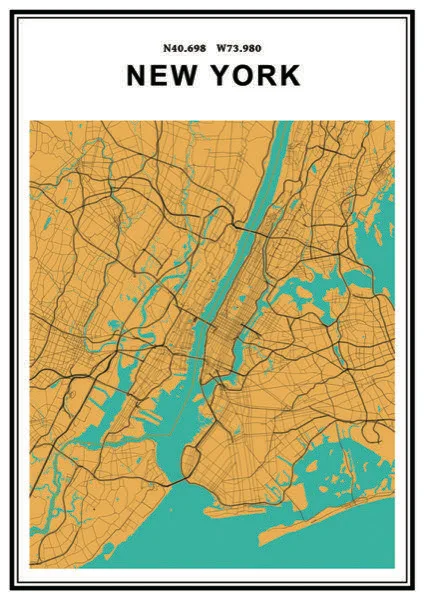
Today, when you look at a MAPDONA map of New York City, you are seeing the result of this 200-year-old plan. The straight lines of Manhattan's grid are not just streets—they are the physical manifestation of American ambition: pragmatic, egalitarian, and relentlessly forward-looking. Every block tells a story of dreams built, neighborhoods transformed, and a city that never stops moving.